
Catalan Christmas traditions: the Tió, the caganer and Sant Esteve
How Catalan children make the tió poo, where the caganer hides, what els Pastorets and the Missa del Gall are, the Christmas food and the 2026 holidays.
On this page (11)
- What is the Tió de Nadal (caga tió)?
- When do you make the tió poo?
- What is a caganer, and why is it in the nativity scene?
- The Catalan nativity scene (pessebre)
- Midnight Mass (Missa del Gall): when is it?
- Els Pastorets: the Christmas play
- What do Catalans eat at Christmas?
- Is 26 December (Sant Esteve) a holiday in Catalonia?
- New Year's Eve and the Three Kings
- Where to see it and buy it in 2026
- Keep reading
At Christmas in Catalonia, children make the tió "poo": a log that leaves presents on the night of 24 December or on Christmas Day. The nativity scene hides a caganer, and the day after Christmas, Sant Esteve, is a second public holiday, the day for canelons. In 2026 Christmas Day is a Friday and Sant Esteve is Saturday 26 December 2026, a holiday across Catalonia except in Aran.
Christmas 2026-27, day by day
- Tió
- Fed from the Immaculada (Tuesday 8 December, a holiday); it "poos" on Christmas Eve or Christmas Day, depending on the family
- Missa del Gall
- Midnight Mass on Christmas Eve, Thursday 24 December (a working day)
- Christmas Day
- Friday 25 December 2026, holiday: escudella i carn d'olla, turrón and neules
- Sant Esteve
- Saturday 26 December 2026, holiday in Catalonia except Aran: canelons
- Three Kings
- Wednesday 6 January 2027, holiday; the parade is on the evening of the 5th
- Fira de Santa Llúcia
- 2026 dates not announced yet (checked on 26 October 2026)
- Pastorets
- 2026-27 season not presented yet; 2025-26 ran from 13 December 2025 to 1 February 2026
Where these facts come from
The holidays are the Generalitat's official calendar, published in its gazette (DOGC). The traditions come from Barcelona City Council's Christmas and Cultura Popular pages and from the Institut d'Estudis Catalans' dictionary. Where those sources disagree about how old a custom is, as they do for the caganer, the nativity scene and els Pastorets, we give no date.
What is the Tió de Nadal (caga tió)?
The Institut d'Estudis Catalans' dictionary defines the tió as the log that, at Christmas, people pretend will "poo" sweets and other presents when it is beaten; hence the Catalan phrase fer cagar el tió, "making the tió poo", and the song that starts "Caga tió". The word itself first means a piece of log for burning in the hearth; it is also called tronc, tronca, soca or rabassa.
Today's tió is a log with a barretina (the traditional Catalan cap) and a painted smiling face, which lives in the house under a blanket so it does not get cold.
Read next
Christmas in Barcelona: lights, nativity and what's open · Living nativity scenes in Catalonia
When do you make the tió poo?
It turns up a few days before Christmas, and the tradition recorded by Barcelona City Council says it starts being fed on the Immaculada, 8 December (in 2026 a Tuesday and a public holiday).
At home, families make it poo on Christmas Eve, 24 December, or on Christmas Day, the 25th: each family follows its own custom. Schools and local associations hold group sessions at their Christmas parties a few days earlier.
How to make the tió poo, step by step
Feed it and cover it
Straw, carob pods, biscuits, mandarins, bread crusts or orange peel: anything goes, so that on the day it gives it all back as presents. And it must have its blanket.
Sing carols first
Children usually sing Christmas carols (nadales) in front of the nativity scene. Some warm or wet the sticks, because they say the tió then poos better.
Beat it and sing
The children hit the tió hard with their sticks while singing the song. There are countless versions, depending on the area and the family.
Lift the blanket
Once the tió is well warmed up, the blanket comes off and the presents appear: by tradition the Christmas lunch desserts, neules and turrón, plus sweets and the odd small gift.
One of the many versions of the song, the one Barcelona City Council gives: "Caga tió, tió de Nadal, no caguis arengades, que són salades, caga torrons, que són més bons!" (Poo, tió, Christmas log, don't poo herrings, they're too salty; poo turrón, it tastes much better!)
What is a caganer, and why is it in the nativity scene?
The caganer (literally "the pooper") is, as the IEC dictionary describes it, a popular figure of the Christmas nativity scene shown relieving himself. The traditional figure is a man in a barretina, squatting with his bottom in the air, smoking a pipe or a cigar and sometimes reading the paper; now and then a piglet sniffs at him from behind.
He is hidden somewhere in the scene, behind a tree or under a bridge, and is said to bring good luck. What he actually means nobody knows for sure: the City Council's Cultura Popular page admits that how to interpret the figure is still debated.
For years figure makers have produced caganers of famous people, from footballers and politicians to actors and singers, and each year's new ones get media coverage. Caganers are also collected: there is even an association, the Amics del Caganer, that researches the figure and puts on exhibitions.
The Catalan nativity scene (pessebre)
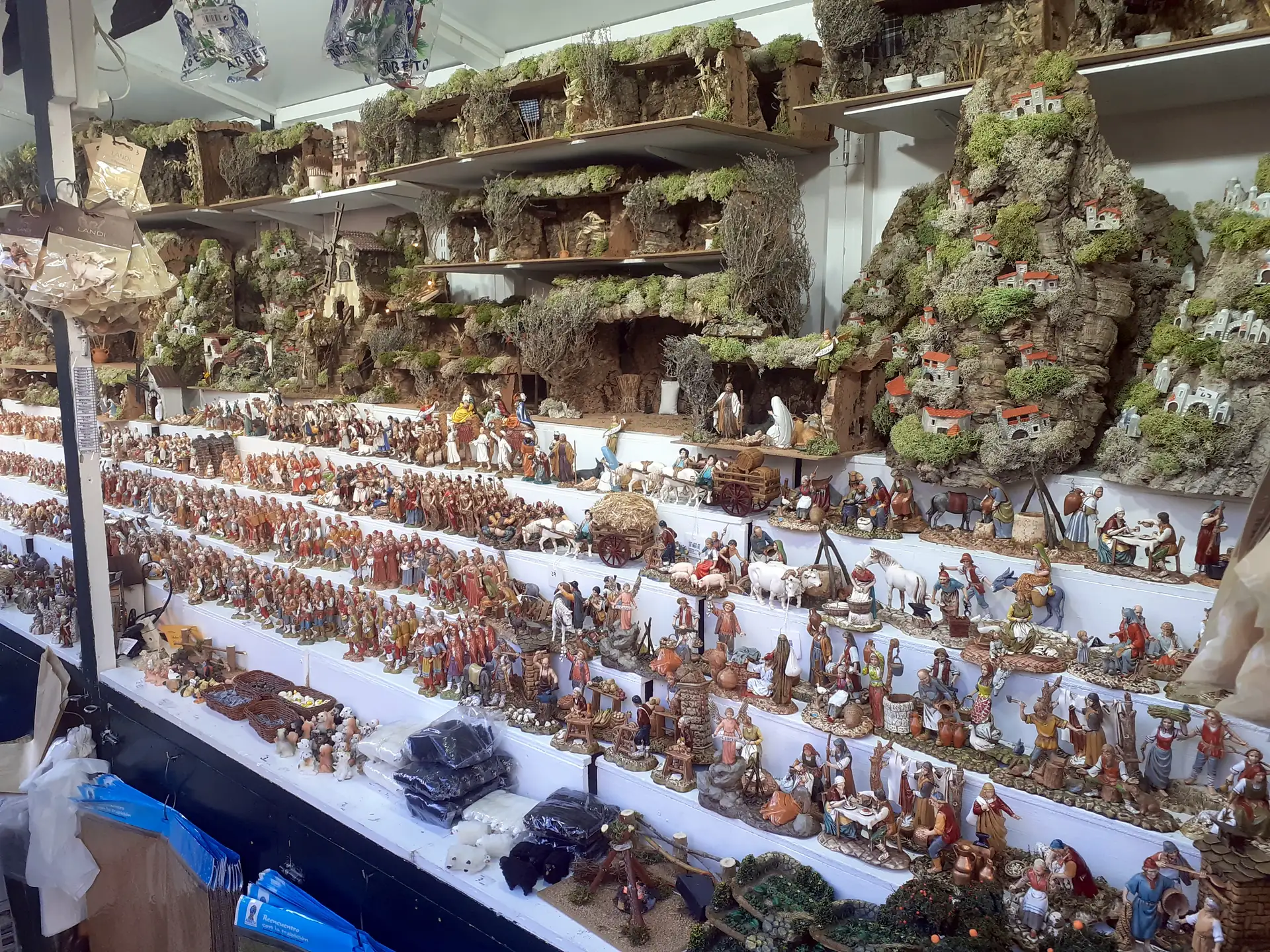
The pessebre is the figurative representation of the birth of Jesus made during the Christmas season, as the IEC dictionary puts it. A traditional Catalan one is built with moss, cork and galzeran (butcher's broom), around the Nativity in a cave or a stable, with Mary, Joseph, the Child, the ox and the mule; the annunciation to the shepherds and the Three Kings complete the story.
Around it go scenes of everyday life, such as the washerwoman, the old woman spinning, a fisherman or shepherds bringing gifts, and, tucked away in a corner, the caganer.
The City Council's own nativity scene on Plaça de Sant Jaume is covered in Christmas in Barcelona, where we add the 2026 dates once they are announced. For a living nativity, the Nativity acted out by people, see the calendar for all Catalonia in our living nativity scenes guide.
Midnight Mass (Missa del Gall): when is it?
The Missa del Gall, literally "the rooster's mass", is the solemn mass held at midnight on Christmas Eve, as the IEC dictionary defines it: the night of 24 to 25 December. In 2026 Christmas Eve is a Thursday and a working day; the holiday is the next day.
In some Barcelona churches the Cant de la Sibil·la is sung before Midnight Mass: a medieval piece of religious drama foretelling the coming of the Messiah and the end of the world, performed by a boy or a woman dressed as the Sibyl, holding a sword. For the 2026 Mass times, check with the parish you want to attend.
Els Pastorets: the Christmas play
Every Christmas, theatres of every size, cultural societies (ateneus), parish halls and civic centres stage Els Pastorets ("The Little Shepherds"), which the City Council calls the play most performed by Catalonia's amateur theatre groups. The plot weaves three stories together: Joseph and Mary looking for lodging until Jesus is born, the fight between angels and devils, and the comic adventures of the shepherds.
There are many versions. Among the best known, the Cultura Popular site picks out El bressol de Jesús o en Garrofa i en Pallanga by Frederic Soler, "Pitarra" (1901), and Els Pastorets o l'Adveniment de l'Infant Jesús by Josep Maria Folch i Torres (1916).
The 2026-27 season has not been presented yet (checked on 26 October 2026). The Coordinadora de Pastorets de Catalunya presented the last one on 29 November 2025, and it ran from 13 December 2025 to 1 February 2026. The Coordinadora's website has a Pastorets finder and a map of its member groups.
What do Catalans eat at Christmas?
On Christmas Day, escudella i carn d'olla. The first course is escudella, a meat and vegetable broth that on this day is made with galets, large pasta shells that are sometimes stuffed with meat. Then comes the carn d'olla, the meat and vegetables cooked in the broth, with the pilota, a big meatball of minced meat, egg, garlic and parsley cut into slices.
For dessert, turrón and neules. Turrón (torró in Catalan) is a sweet block of roasted almonds, hazelnuts, pine nuts or walnuts mixed with honey or egg; a neula is a thin sheet of flour, sugar and egg white rolled into a tube, usually served with turrón and cava. Among the best-known kinds of turrón, the City Council names those of Xixona, Alicante and Agramunt.
Torró d'Agramunt has Protected Geographical Indication status: according to the Generalitat's agriculture department, it is made in the municipality of Agramunt (Urgell) from hazelnuts or almonds, sugar, honey and egg white, in bars covered with wafer paper, and the pack must carry the name "Torró d'Agramunt. Indicació Geogràfica Protegida" and the logo.
On Sant Esteve, canelons. Catalan cannelloni are filled with the roast meat left over from Christmas lunch, which is what sets them apart from the Italian kind, made with minced meat and tomato sofregit. Sheets of pasta are filled, rolled, covered with béchamel and browned with cheese.
Is 26 December (Sant Esteve) a holiday in Catalonia?
Yes. Saturday 26 December 2026 is a public holiday across Catalonia, according to the official calendar of work holidays (Ordre EMT/66/2025). The exception is Aran, where the Festa d'Aran, held on Wednesday 17 June 2026, replaces it, so 26 December is a working day there.
It is not a holiday everywhere in Spain: in the BOE's table for 2026, 26 December is a holiday only in Catalonia and the Balearic Islands. Nor is it a holiday every year: in 2027, 26 December is a Sunday and does not appear in the calendar of work holidays (Ordre EMT/52/2026).
It is the day for getting together again, above all with the side of the family you did not spend Christmas with; as the Catalan saying goes, "Per Nadal, cada ovella al seu corral; per Sant Esteve, cada ovella a casa seva" (at Christmas every sheep in its fold, on Sant Esteve every sheep in its own home). What is open on 25 and 26 December is in Christmas in Barcelona and our guide to shops open on Sundays and holidays.
New Year's Eve and the Three Kings
New Year's Eve, with the twelve grapes and the city's celebration, has its own guide: New Year's Eve in Barcelona. The Three Kings arrive on the evening of 5 January, and Wednesday 6 January 2027 is a public holiday in Catalonia (Ordre EMT/52/2026); the times and route of Barcelona's parade will be added to that same guide once they are published.
Where to see it and buy it in 2026
- Fira de Santa Llúcia, in front of Barcelona Cathedral, where it has been held since 1786: it has a section for nativity scenes and figures, caganers included, and a greenery section with moss, cork and tió logs. The 2026 dates have not been announced yet (checked on 26 October 2026): the organisers' website still shows the 2025 calendar, and the City Council says it will update its Christmas website around November. According to the council, the fair goes up every year in late November or early December, always before 13 December, Santa Llúcia's day. Dates and the other fairs are in our Christmas markets guide.
- The Plaça de Sant Jaume nativity scene: see Christmas in Barcelona.
- Living nativity scenes across Catalonia, with the dates already official: our living nativity scenes guide.
- Pastorets: the Coordinadora de Pastorets de Catalunya's Pastorets finder.
- What is the caga tió?
- A log that Catalan children feed and keep under a blanket in the run-up to Christmas. On Christmas Eve or Christmas Day they beat it with sticks while singing "Caga tió", and it "poos" presents: sweets, turrón, neules and small gifts.
- When do Catalans make the tió poo?
- On Christmas Eve (24 December) or Christmas Day (25 December), depending on the family. It is fed for some days beforehand; by tradition from 8 December, the Immaculada.
- Why is there a caganer in the nativity scene?
- He is said to bring good luck, especially when well hidden behind a tree or under a bridge. What the figure actually means is still debated: there is no single explanation.
- Is 26 December 2026 a public holiday in Catalonia?
- Yes. Saturday 26 December 2026, Sant Esteve, is a holiday across Catalonia except in Aran, where the Festa d'Aran (17 June) replaces it. In 2027, 26 December falls on a Sunday and is not a holiday.
- What do Catalans eat at Christmas?
- On Christmas Day, escudella (broth with galets pasta) and carn d'olla, with turrón and neules for dessert. On Sant Esteve, canelons made with the roast meat left over from Christmas lunch.
- When is the Missa del Gall?
- At midnight on Christmas Eve, between 24 and 25 December. In 2026, 24 December is a Thursday and a working day.
- Where can I buy a caganer or a tió in Barcelona?
- At the Fira de Santa Llúcia in front of Barcelona Cathedral, which has a section for nativity figures (caganers included) and another for moss, cork and tió logs. Its 2026 dates have not been announced yet.
Data on this page last verified: 26 October 2026.
Keep reading
Sources
This page cites official and primary sources. If you spot an error, let us know.
- Ordre EMT/66/2025, de 30 d'abril, calendari oficial de festes laborals a Catalunya per a l'any 2026 — DOGC
- Ordre EMT/52/2026, calendari oficial de festes laborals a Catalunya per a l'any 2027 — DOGC
- Resolución de 17 de octubre de 2025, de la Dirección General de Trabajo, relación de fiestas laborales para el año 2026 — BOE
- Tradicions de Nadal — Ajuntament de Barcelona
- Tió — Ajuntament de Barcelona, Cultura Popular
- Caganer — Ajuntament de Barcelona, Cultura Popular
- Pessebre — Ajuntament de Barcelona, Cultura Popular
- Pastorets — Ajuntament de Barcelona, Cultura Popular
- Cant de la Sibil·la — Ajuntament de Barcelona, Cultura Popular
- Reis d'Orient — Ajuntament de Barcelona, Cultura Popular
- Cavalcada de Reis — Ajuntament de Barcelona, Cultura Popular
- Escudella de Nadal — Ajuntament de Barcelona, Cultura Popular
- Canelons — Ajuntament de Barcelona, Cultura Popular
- Torrons — Ajuntament de Barcelona, Cultura Popular
- Neules — Ajuntament de Barcelona, Cultura Popular
- Fira de Santa Llúcia — Ajuntament de Barcelona
- Fira de Santa Llúcia: calendari 2025 — Associació Fira de Santa Llúcia
- Nadal a Barcelona — Ajuntament de Barcelona
- Diccionari de la llengua catalana (DIEC2): tió, caganer, pessebre, missa del gall — Institut d'Estudis Catalans
- IGP Torró d'Agramunt — Generalitat de Catalunya, Departament d'Agricultura
- Presentació de la temporada de Pastorets 2025-2026 — Coordinadora de Pastorets de Catalunya
- Cercador de Pastorets — Coordinadora de Pastorets de Catalunya
Was this page useful?
Related content
Christmas in Barcelona 2026: lights, nativity scene and what's open
Christmas in Barcelona in 2026: the lights switch-on and the lit streets, the nativity scene, what is open on the holidays, the metro and the traditions.
Christmas markets in Barcelona and Catalonia 2026: dates and places
Christmas markets in Barcelona and Catalonia in 2026: the dates organisers have confirmed, last year's dates for the rest, and where each one is held.
Catalonia school calendar 2026-2027: term dates, Christmas, Easter and days off
Official term dates for 2026-2027, 2027-2028 and 2028-2029: start, end, Christmas, Easter, the year's days off and whether schools are open today.

Autumn food festivals in Catalonia 2026: October and November dates
Chestnuts in Viladrau, coca i mató in Monistrol, mushrooms in Cardona, wine in Gandesa and new oil in Reus, Maials, Barcelona and Tarragona: the official 2026 dates.